Cart
0

How to choose a notary journal
The best notary journal is the one you'll actually fill out completely at every signing — with enough entries to last, paper that won't bleed through, and a binding that stays open on the table. Start with your state's journal rules, then compare entry capacity, paper quality, and whether you work at a desk or on the road.
Check your state's journal rules first!
Journal rules are legal requirements, not preferences — and they differ by state. Some states require a journal by law and specify what each entry must contain; others leave it to the notary's judgment. Before you buy, confirm what your commissioning authority requires (the National Notary Association maintains state-by-state journal requirement guidance if you need a starting point).
Everything below is workflow advice — how to pick a journal that fits the way you work — not legal advice. Your state's rules always win.
Count the entries, not just the pages
A journal's real lifespan is measured in entries, not pages. A journal with 568 numbered entries covers about 190 signings if you average three entries per signing — roughly a year of steady part-time work. Do the math for your own volume: a mobile notary handling five signings a week burns through a thin journal in months, then has to switch books mid-year and keep two archives.
Numbered entries also make your journal easier to search later. When a signer calls back asking for a copy of an entry from March, "entry 412" beats flipping through unnumbered pages.
Paper quality and binding matter more than you think
You'll write in this journal hundreds of times — often quickly, sometimes in a car. Three things to check:
• Acid-free paper that won't yellow or degrade over years of archiving.
• Ink-friendly pages that don't bleed through — especially if you journal with gel pens.
• A binding that lies flat. A journal that snaps shut mid-entry is a journal that gets filled out later "from memory," which is exactly what you don't want.
Structured entry pages with checkboxes and dedicated signature space are worth prioritizing: they keep every entry consistent and speed up the signing table workflow.
Match the journal to how you work
A desk-bound notary can use a larger, heavier journal that never leaves the office. A mobile notary needs something that fits the bag, opens flat on a car hood or a kitchen table, and survives being carried to dozens of signings.
If you do loan signings with multiple signers, favor a journal with generous signature space per entry — cramped lines slow you down when three people need to sign.
Two journals made for this work
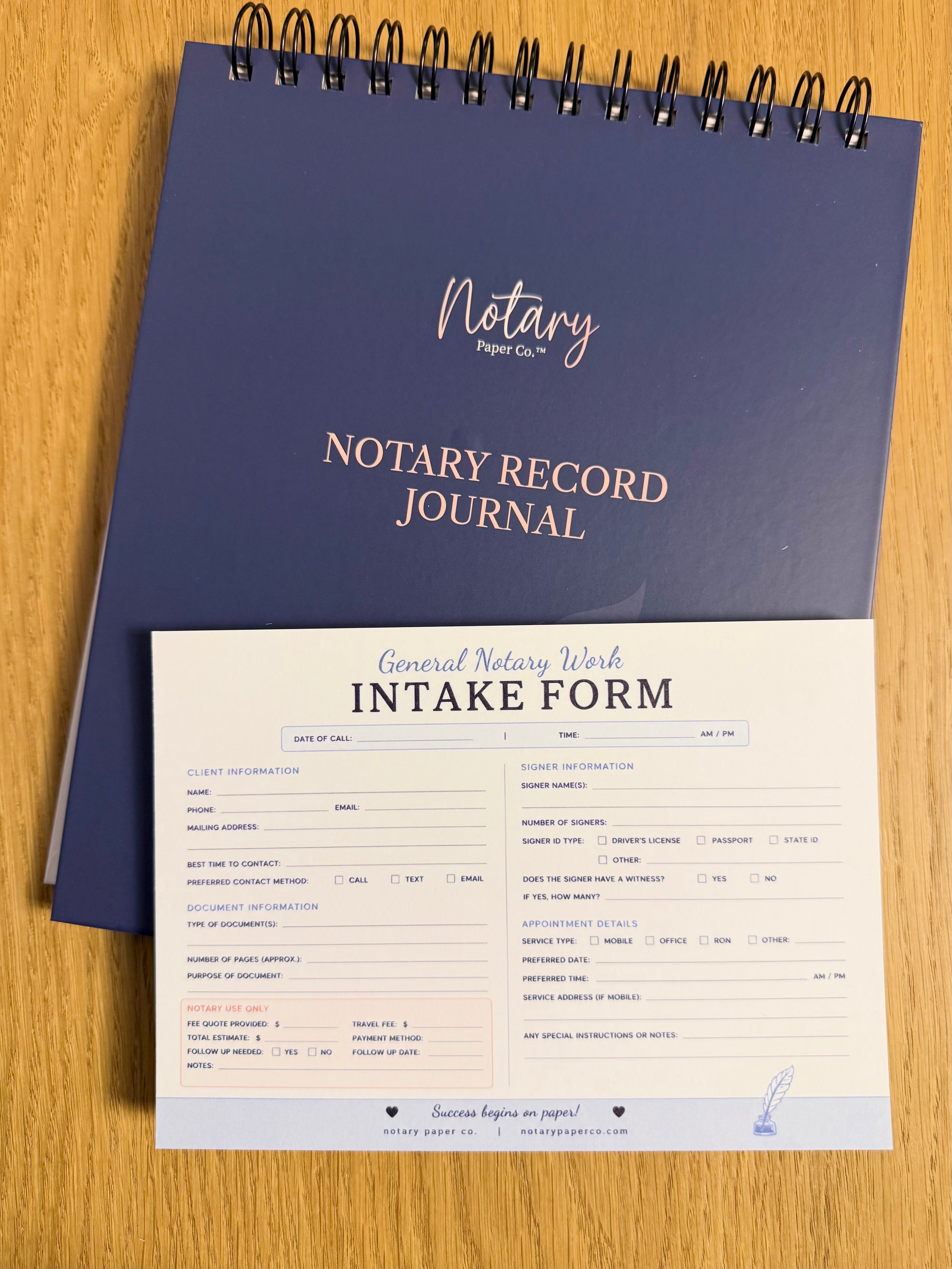
If you want a workhorse, the Notary Public Logbook gives you 568 numbered entries, easy check boxes, signature space, lie-flat binding, and acid-free paper — built for daily signings at a working-notary price.
If you want something more premium, the Clever Fox Notary Journal pairs a lay-flat design with structured entry pages that keep every record clean and professional.
Browse the full notary Journals & logbooks collection to compare them side by side.